PMNs-WaterSense - High-Precision mmWave Water Level Sensing Using the TMYTEK BBox 5G Beamformer
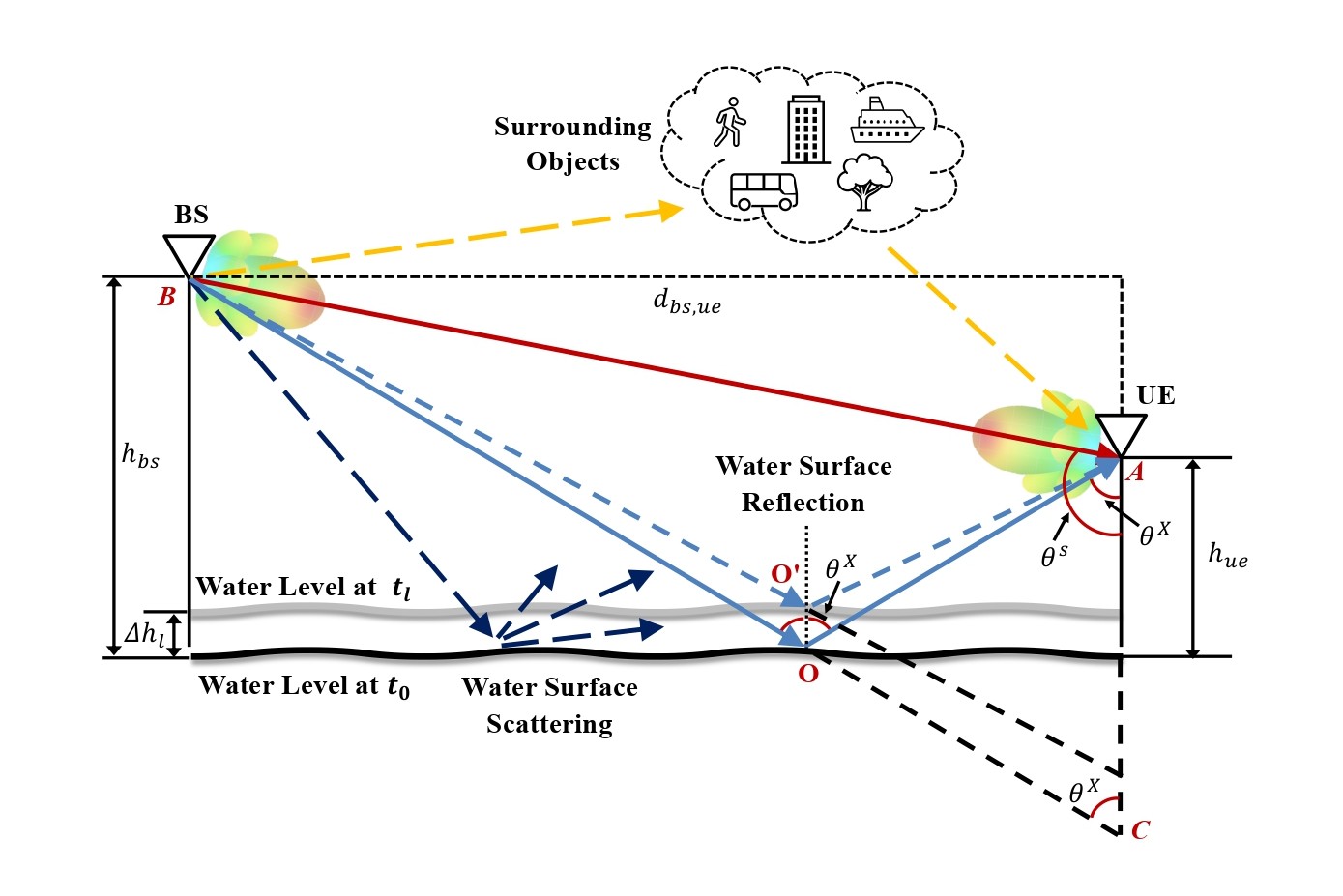
Cover — PMNs-WaterSense water sensing geometry: water level height is inferred from variations in the reflection path between the Base Station (BS) and User End (UE).
This water-level variation sensing use case was developed by researchers from University of Technology Sydney’s Global Big Data Technologies Centre, including Prof. J. Andrew Zhang, Dr. Zhongqin Wang, and other researchers, using TMYTEK’s mmWave platform. The implementation and experimental evaluation were primarily led by Dr. Zhongqin Wang.
Executive Summary
With the rise of Integrated Sensing and Communication (ISAC) and Perceptive Mobile Networks (PMNs), wireless signals have evolved from pure data carriers into a powerful medium for environmental monitoring. The Global Big Data Technologies Centre (GBDTC) team at the University of Technology Sydney (UTS) has developed an innovative framework called PMNs-WaterSense, which leverages Channel State Information (CSI) from existing communication infrastructure to sense water level variations in real time, without deploying any dedicated sensors.
Explore mmW-SDR Channel Sounding Capabilities
This use case adopts the TMYTEK BBox 5G as the mmWave front-end, building a single-antenna, low-cost, yet highly sensitive bi-static sensing platform at 28 GHz. In a controlled lab environment, the system achieved an average water level estimation error of only 0.025 cm, leveraging the short wavelength characteristics of mmWave signals to capture small physical displacements. The same algorithm was further extended to a lower-frequency outdoor river scenario, where the average error remained within a few cm for a 1-meter water level change — demonstrating that the high-precision sensing technique developed using the mmWave platform can generalize across frequencies and across environments.
Challenges
- Phase distortion in bi-static systems: clock asynchrony between separated transmitter and receiver introduces significant random phase offsets (TO/CFO) on CSI. Traditional fixes rely on multi-antenna calibration or expensive time/frequency synchronization hardware, making single-antenna deployment difficult.
- Extracting weak reflected signals: water-surface reflections are extremely weak compared with the line-of-sight (LOS) path and are easily masked by dynamic noise (pedestrians, vehicles, wind, branches), demanding high-resolution delay/Doppler analysis.
- Limited resolution of conventional sensing: although traditional methods are reliable and accurate, their resolution is often insufficient at scale to capture the millimeter-level water level variations required by precise flood warning and environmental monitoring applications.
The TMYTEK Solution
The UTS team built a modular, reconfigurable 28 GHz mmWave sensing platform using the TMYTEK BBox 5G (Beamformer) together with the TMYTEK UD Box (Up/Down Converter). The platform supports "rapid configuration", "phase stability", and "repeatable measurement" —allowing researchers to focus on sensing algorithm development.
See Inside the mmW-SDR Architecture
Core Hardware Configuration
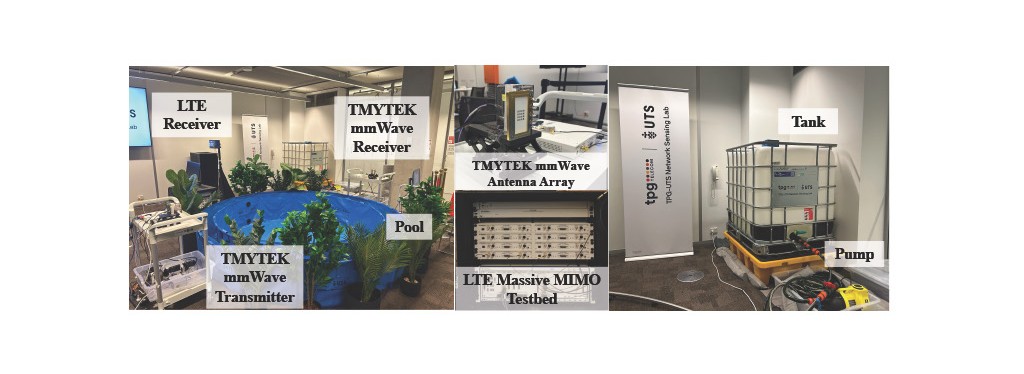
- mmWave front-end — TMYTEK BBox 5G (28 GHz): provides high-linearity, low-phase-noise analog beamforming as a single-channel phased-array transceiver, supporting fine ±45° beam steering and stable acquisition of high-quality CSI.
- Frequency conversion core — TMYTEK UD Box: up-converts the back-end SDR's 3.5 GHz IF signal to 28 GHz mmWave and down-converts received signals back. It bridges the digital and mmWave worlds, with software-controlled frequency synchronization to support phase-consistent measurements.
- System geometry: transmitter and receiver are fixed 1 m above ground and separated by 5 m, emulating a real "Base Station (BS) — User End (UE)" bi-static sensing scenario; a central pool driven by an electronic pump induces 3.5 cm water level variations over 8 minutes.
Why 28 GHz mmWave?
In ISAC/PMNs research, 28 GHz mmWave offers significant advantages over conventional Sub-6 GHz bands:
- Fine spatial resolution: the 28 GHz wavelength is only ~1.07 cm — far shorter than LTE (~9.7 cm). Short wavelengths are sensitive to small surface displacements, enabling millimeter-level water level resolution.
- Touchstone for advanced algorithms: the CSI measurements obtained from the TMYTEK BBox 5G support the development and evaluation of advanced signal-processing algorithms (phase unwrapping, multi-domain filtering, Kalman tracking) under the most demanding conditions; once validated at high frequency, these algorithms transfer robustly to Sub-6 GHz systems.
- Relevance to emerging 5G/6G ISAC research: 28 GHz is a key band for future 6G ISAC. Research outcomes here directly map to smart-city, ultra-precise sensing, and next-generation mobile communication scenarios.
Core Technological Capabilities Supported by TMYTEK BBox 5G
1. High-quality CSI measurement: the BBox 5G's low phase noise and stable gain produce clean CSI from a single-antenna transceiver, helping reduce hardware-induced phase and gain variations during processing.
2. Precise phase stability: the locked-loop design of UD Box and BBox 5G allows phase offsets within a sampling window to be treated as a slowly varying term. Combined with the CSI Power Method, this enables single-antenna clock-asynchrony compensation — eliminating the need for costly multi-antenna synchronization.
3. Flexible modular architecture: Adding a single set of BBox and UD Box to an existing communication chain upgrades it into a high-precision sensing node, simplifying experimental prototyping for ISAC/PMNs research.
Discover how TMYTEK simplifies 5G mmW SDR prototyping
Methodology & Simplified Algorithm
PMNs-WaterSense does not rely on complex hardware synchronization. Instead, a "physical-layer + signal-processing" three-step pipeline turns CSI captured by the BBox 5G into millimeter-level water level data.
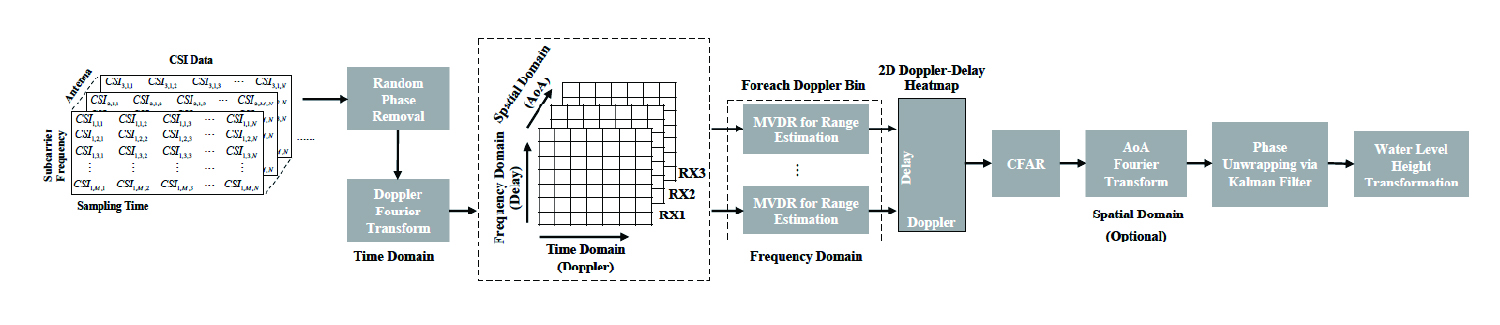 Fig. 1 — PMNs-WaterSense signal processing pipeline: from raw CSI through phase-offset removal, Doppler/delay MVDR, CFAR detection, and Kalman-based phase unwrapping, to final water level height conversion.
The 3-Step Sensing Pipeline
1. Random Phase Offset Removal (CSI Power Method): multiplying CSI by its conjugate (|CSI|²) eliminates random phase offsets caused by TO/CFO and antenna hardware in a single step — the key breakthrough enabling single-antenna, asynchronous PMNs-WaterSense operation.
2. Multi-domain Filtering: combining slow-time Doppler FFT with frequency-domain MVDR delay estimation and 1D CFAR detection isolates the slowly-varying water-surface reflection from dynamic clutter such as pedestrians, vehicles, and wind.
3. Kalman-based Tracking & Height Conversion: a Kalman filter resolves the 2π ambiguity in phase unwrapping, after which transceiver geometry (BS/UE heights and horizontal distance) converts phase variations into precise water level height.
Experimental Results
Controlled Lab Environment
- Signal source: TMYTEK BBox 5G (28 GHz), 70 MHz bandwidth, 46 subcarriers, 100 Hz CSI sampling rate.
- Scenario setup: transmitter and receiver placed on opposite sides of the pool, 5 m apart at 1 m height. An electronic pump cycled fill/drain over 8 minutes to emulate 3.5 cm water level variations; a millimeter-accurate ultrasonic sensor served as the ground truth.
- Key results (28 GHz mmWave band):
- In-flow estimation error: 0.021 cm
- Out-flow estimation error: 0.029 cm
- Overall average error: 0.025 cm — comparable to industrial-grade ultrasonic water level gauges.
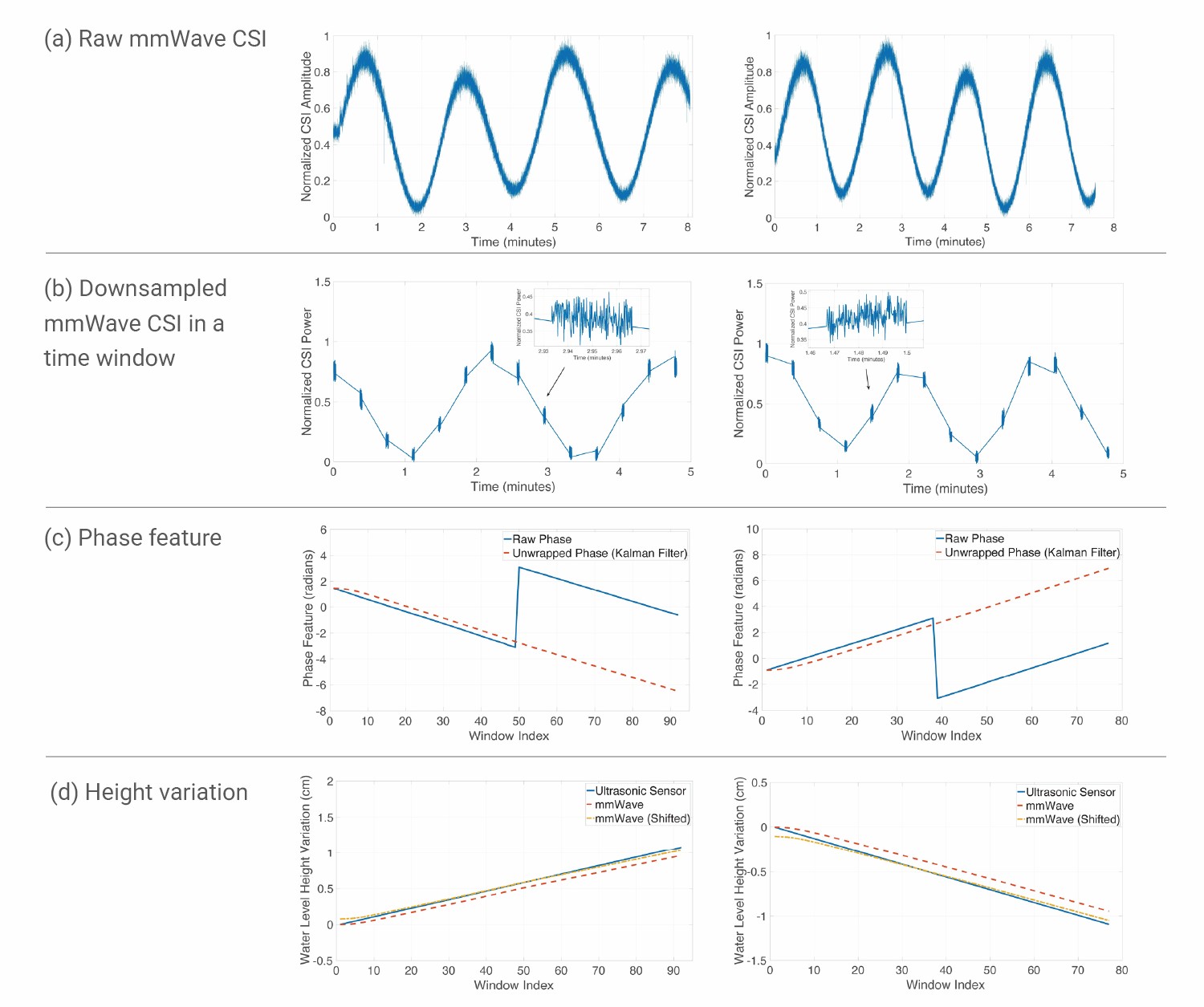 Fig. 2 — Lab results at 28 GHz mmWave: (a) raw CSI amplitude, (b) downsampled CSI within a time window, (c) phase feature after Kalman-based unwrapping, (d) estimated water level vs. ultrasonic ground truth (left: in-flow, right: out-flow).
Real-world Outdoor Validation
To verify that the PMNs-WaterSense algorithm generalizes across frequencies and environments, the UTS team applied the same signal-processing pipeline to a lower-frequency outdoor field test at the Parramatta River in Sydney, Australia (river width ~260 m). The downlink signals from mobile base stations were captured using a software defined radio device, placed with distances ranging from a few meters to about one hundred meters to the river.
- Scenario challenges: wide river surface, transceiver separation of hundreds of meters, and severe multipath interference from ferries, vehicles, and pedestrians.
- Key results: against a 1-meter tidal water level change, the average estimation error was only 4.8 cm with a 2.5 cm standard deviation, successfully recovering the tidal curve and demonstrating practical applicability.
- Technical implication: this result reinforces the strategy of "calibrating algorithms first on TMYTEK's high-quality 28 GHz CSI, then transferring to lower bands" — supporting the transition from controlled experiments to practical deployments.
Check TMYTEK x NI mmW-SDR Integration
Conclusion
This use case demonstrated the feasibility of using the TMYTEK BBox 5G and UD Box for mmWave sensing research in 6G ISAC/PMNs. Using the BBox 5G, the UTS team was able to:
- Demonstrate high-precision sensing capability : match industrial ultrasonic gauges (0.025 cm accuracy) without deploying dedicated radar or specialized sensors.
- Develop scalable algorithms: algorithms calibrated on the mmWave platform extend directly to lower frequencies and real outdoor scenarios — demonstrating applicability in both laboratory and outdoor environments.
- Enable real-world applications: the technology is broadly applicable to:
- Urban flood early-warning — monitoring water levels in low-lying areas via existing telecom infrastructure.
- Smart agriculture and industrial liquid-level management — precise control of irrigation, chemical tanks, and factory liquid levels.
- Water resource and environmental monitoring — tracking rivers, lakes, and reservoirs through communication networks.
This proves that TMYTEK's mmWave solution is an effective experimental platform for academic and research teams developing the next generation of ISAC applications.
Reference:
[1] Zhongqin Wang, J. Andrew Zhang, Kai Wu, and Y. Jay Guo, Passive Water Level Sensing Using Communication Signals, IEEE Global Communications Conference, 2025. (To appear)
[2] Zhongqin Wang, J. Andrew Zhang, Kai Wu, and Y. Jay Guo, Water Level Sensing via Communication Signals in a Bi-Static System, arXiv preprint arXiv:2505.19539, 2025.