AI-powered Predictive Integrated Sensing and Communication in Smart Radio Environments

Introduction:
Modern industrial environments demand ultra-reliable wireless connectivity. While millimeter-wave (mmWave) frequencies offer the high data rates required for these applications, they are fundamentally challenged by their sensitivity to blockages. The research team at the University of Bologna set out to realize the concept of a Smart Radio Environment (SRE) by integrating sensing and communication. The goal is to prove that a network could perceive its environment through real-time radar sensing and dynamically adapt to maintain a reliable and stable connection.

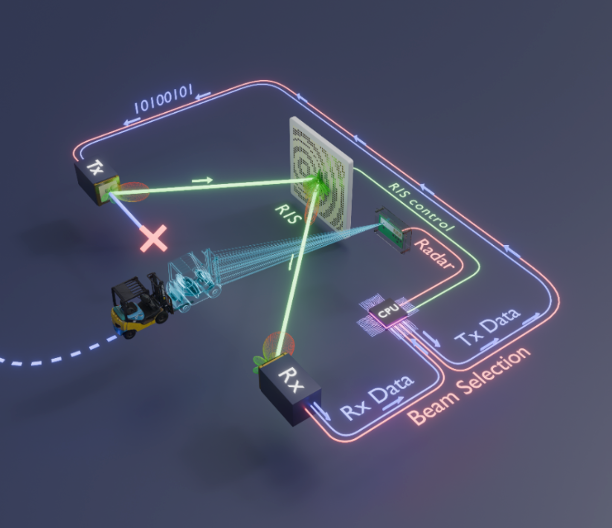 Figure 1: Closed-loop RIS control: utilizing radar data for dynamic beam selection between Tx and Rx.
Challenge
At mmWave frequencies, path loss is mitigated by using antenna arrays that create highly directional, narrow beams. However, in harsh, dynamic industrial scenarios, moving objects such as forklifts or workers can easily block these directional links. This causes sudden loss of Line-of-Sight (LOS), beam misalignment, severe degradation of link reliability, and ultimately, service interruptions in critical applications. The core challenge is shifting from a reactive network to a proactive one: answering the question of how to predict an imminent blockage condition so the network could activate a backup link before the primary connection drops.
Solution
To solve this, a point-to-point wireless communication link operating at 28 GHz in an indoor laboratory is deployed. Both the transmitter and receiver are equipped with TMYTEK BBox One & Lite front-end antennas to ensure dynamic directional beamforming. A 28 GHz test signal is generated using a Software Defined Radio (SDR) device and a TMYTEK UD Box 5G up-converter before being sent to the transmitting antenna array. On the receiving side, the signal is down-converted via the TMYTEK UDBox and fed into a second SDR to estimate received power in real-time.
Learn More About TMYTEK’s Advanced 5G mmW SDR Platform
A 77 GHz FMCW MIMO radar continuously monitors the environment and localizes moving objects, while a central processing unit (CPU) collects and processes its raw data, runs prediction and multi-object tracking algorithms, and orchestrates the system. To provide a proactive backup communication link, a mmWave Reconfigurable Intelligent Surface (RIS) is installed to create an alternative Non-Line-of-Sight (NLOS) path. When the system predicts an imminent LOS blockage, the CPU proactively reconfigures the beamforming parameters and the RIS in real-time.
Specifically, the CPU processes raw radar measurements by generating range-angle and range-Doppler maps to isolate moving targets from static clutter. Then, detections are processed using an unsupervised machine learning approach, through the DBSCAN algorithm, to autonomously group data points and identify different targets. A Kalman filter is applied to each tracked object, coupled with a Joint Probabilistic Data Association (JPDA) framework that maps measurement-to-track association even in multi-target scenarios. The algorithm then extrapolates the filtered trajectories to calculate potential intersections with the direct link. If a blockage is forecasted, the CPU proactively reconfigures the network to activate the RIS link. By adjusting beamforming parameters in real-time, the system prevents outages and ensures seamless connectivity. Future developments will integrate neural networks to predict complex, non-linear trajectories.
Results
In Figure 2, the Received Signal Strength Indicator (RSSI) is used as the main performance metric to validate the proposed predictive algorithm.
In the upper part of the figure, when a person crosses the LOS path and the prediction algorithm is disabled, the system is unable to react in time. This causes a power drop of more than 20 dB, with the received power dropping below the -50 dBm threshold and resulting in a complete communication outage. Such a strong attenuation is expected in 28 GHz mmWave communication systems, where even the human body can severely block the propagation path due to the limited diffraction capability and the high penetration loss.
In the lower part of the figure, when the prediction algorithm is enabled, the obstacle movement is anticipated. Before the person blocks the LOS path, the CPU proactively triggers a RIS link switch toward an alternative path. As a result, the communication link is preserved during the blockage event, and the power reduction is limited to approximately 7 dB instead of the abrupt 20 dB drop observed without prediction.
These results demonstrate that the proposed SRE substantially improves link reliability in dynamic mmWave industrial environments. By integrating radar sensing with predictive control, the system can accurately track moving obstacles in real time and prevent communication interruptions before they occur.
Explore TMYTEK Smart Reflector Solutions for Eliminating mmWave Dead Zones
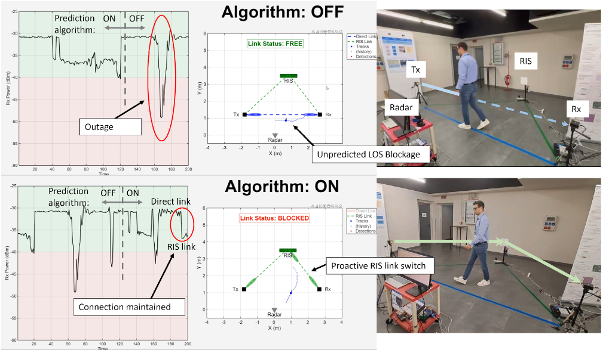
Figure 2: Real-time received power (RSSI) monitoring. The plots demonstrate how the predictive algorithm prevents the signal from dropping below the communication threshold during the obstacle transit.